Bills of quantities and estimates
Padel Court Construction Cost in 2026: Component Breakdown, Standard Size & Choosing a Contractor
Padel court construction cost in 2026: component breakdown, the standard 10 x 20 m size, outdoor vs indoor, a budget example and contractor tips.
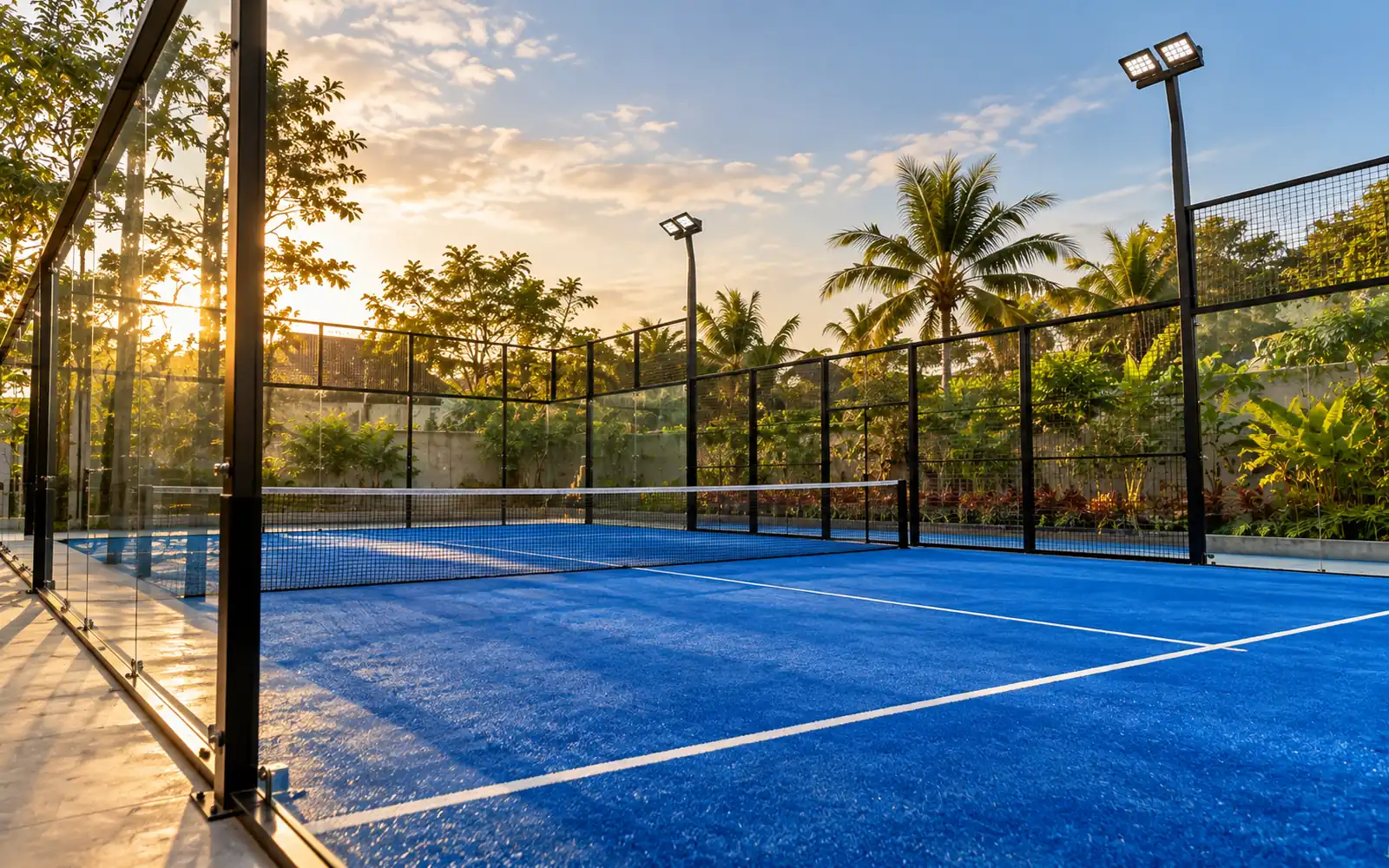
Kaca, rangka baja, dan pekerjaan sipil biasanya menjadi pos terbesar dalam anggaran lapangan padel.
Padel is growing fast in Indonesia's big cities, and landowners, sports centre operators, hotels and developers are working out whether to build courts of their own. The first question is always the same: what does a padel court cost to build, and what are you actually paying for?
This guide breaks down the cost of one court by component, the dimensions you must meet, outdoor versus indoor, a budget example, and what to check before choosing a padel court contractor.
Standard padel court dimensions
Before talking money, make sure your land is big enough. Under the official International Padel Federation (FIP) rules:
- Playing area: a 10 × 20 m rectangle (interior), with 0.5% tolerance.
- Clear height: at least 6 m over the whole court with no obstructions; at least 8 m is suggested for new facilities. This matters if you plan a roof.
- Back walls: 4 m high in total, the lower 3 m solid (usually glass) and the rest metal mesh. Several side-wall layouts are allowed.
- Surface: concrete, synthetic material or artificial grass, in green, blue or terracotta. Level differences inside the court must be under 3 mm measured with a 3 m straightedge.
- Lights: mounted at least 6 m above the floor (8 m suggested for new facilities if above the court).
So the land for one court must be larger than 200 m², because you need space around it for circulation, player exits, light poles, drainage and maintenance access.
What a padel court costs, by component
A padel court is several packages of work. The breakdown below is a general range from a specialist contractor for one outdoor, commercial-standard court (12 mm tempered glass, galvanised steel frame, padel turf, LED lighting):
- Preparation and design: about Rp15–25 million. Survey, setting out, technical drawings.
- Civil and concrete works: about Rp130–170 million. Clearing and compaction, foundations, concrete slab, drainage.
- Steel frame and glass: about Rp180–230 million. The most expensive and most safety-critical part.
- Artificial turf and silica sand: about Rp55–75 million.
- Lighting and electrical: about Rp25–40 million.
- Accessories and finishing: about Rp10–20 million. Net, player doors, lines.
That source puts the total at about Rp415–560 million per outdoor court. Another contractor gives a wider range of roughly Rp350–900 million for outdoor courts, reflecting differences in spec and whether a canopy is included.
One thing that often surprises investors: the advertised court "kit" price (frame, glass, turf, lights) is only part of the total. Civil works such as sub-base, slab and drainage can match or exceed the kit price.
Know the main materials: glass, frame and turf
Tempered glass. The glass walls are both a rebound surface and a barrier. Specialist contractors cite a minimum of 10 mm for player safety, and many commercial packages use 12 mm. Ask about clamps and bolts too; strong glass is still dangerous on weak fixings.
Steel frame. Usually galvanised to resist rust, with square hollow sections as a minimum and stiffer profiles for premium courts. Near the coast or in very humid locations, anti-corrosion coating matters even more.
Padel turf. Not the same as futsal turf. Padel turf typically uses curled monofilament fibre about 12 mm high with silica sand infill only, no rubber crumb, so the ball bounces consistently. Using futsal turf to save money changes how the game plays.
Base slab. Turf is only as good as the floor underneath. The concrete slab must be flat with the right fall or drainage. FIP rules cap the cross slope at 1% for surfaces without drainage.
Converting an old court to padel
Many sports centre owners look at turning an old tennis or futsal court into padel. This can save some civil work if the existing slab is still sound, flat and draining properly. Check first:
- Whether the land fits 10 × 20 m plus space around it.
- Whether the old slab is cracked, settled or ponds in rain. If so, civil repairs are still needed.
- Whether the roof clear height (for an indoor court) meets the 6 m minimum.
- Whether existing light poles or building columns get in the way of play.
The survey decides whether conversion is really cheaper than building from scratch.
Questions to ask during the survey
- How thick is the glass and what steel profile is used?
- Which turf brand and spec, and is the infill silica sand?
- How many light points, at what height, and what lighting target?
- How does floor drainage work and where does the water go?
- Is the site's power supply enough, or does it need upgrading?
- What is excluded from the quote?
- How long will it take, and how is the work sequenced around your opening date?
Outdoor, covered or fully indoor
Outdoor is cheapest up front, but rain stops play and materials age faster in heat and UV. Surface drainage becomes critical.
A canopy or open roof protects from rain and sun. Market ranges for a roof or canopy structure are about Rp100–300 million per court depending on type and materials. The 6 m minimum clear height (8 m suggested) still applies, so the structure is tall and long-span.
Fully indoor costs the most. One specialist estimates about Rp900 million–1.5 billion per court, because of long-span roofing, roof drainage and good airflow in a tropical climate. The payoff is all-weather operation.
What pushes the cost up or down
- Ground and site level. Soft ground or land that needs filling adds to civil costs.
- Glass and frame spec. Glass thickness, steel profiles and fixings drive both price and safety.
- Turf type. Padel turf uses specific fibres with silica sand infill, unlike futsal turf.
- Lighting standard. Daily rental courts need adequate light; broadcasting or filming matches needs far higher vertical lighting (FIP cites at least 1000 lux).
- Number of courts. Building several at once can make mobilisation and civil works more efficient.
- Access. Busy corridors or limited truck access mean deliveries have to be planned.
- Support facilities. Changing rooms, toilets, reception, parking and waiting areas are usually outside the court price.
Padel court estimates at MEETS
In the MEETS padel court catalogue, the rate starts from Rp1,575,000 per m². For a 10 × 20 m court, that is about Rp315 million per outdoor court, excluding a canopy. The final price depends on the number of courts and the specification after a survey.
According to the package description, scope covers site preparation and levelling, sub-base, a sports floor with artificial turf, glass walls and fencing, line marking and basic lighting. Because glass, frame and lighting specs vary so much, we write the final details into the quotation so you can compare it line by line with others.
Structural warranty is 5 years, finishes and installations 2 years from handover; manufactured products such as lights follow the factory warranty. Payments follow progress: 30% down, then 17.5% at each of 25%, 50%, 75% and 100% physical progress on handover.
If you are considering other sports on the same land, MEETS also offers pickleball courts (about Rp150 million per outdoor court, lights excluded) and futsal and multi-sport courts from Rp630,000 per m².
Budget example: two outdoor courts
Say you have flat, empty land and want two outdoor courts to rent out.
- Courts: 2 × about Rp315 million = about Rp630 million (MEETS estimate, outdoor, no canopy).
- Canopy (optional): market range about Rp100–300 million per court.
- Support facilities: changing rooms, toilets, waiting area, parking; priced separately to the design.
- Permits and electricity connection.
- A 10–15% reserve for site conditions that only appear after the survey.
This shows that a venue budget is not the same as a court budget. Many investors only count the courts, then get a shock when facilities and roofing are added.
How long it takes
Specialist contractors commonly quote about 6–10 weeks per court from the start of civil works, depending on the site and whether there is roofing. Courts with a canopy or enclosure take longer. Ask for the schedule in writing in the quotation, aligned with your opening date.
Maintenance once the court is built
Building is only the start. To keep the court safe and pleasant to play on, set up a maintenance routine from day one:
- Turf: brush regularly so the silica sand stays evenly spread and the fibres stand up; top up sand in high-traffic areas near the net and service lines.
- Glass and frame: check bolts, clamps and joints routinely, especially after the rainy season; clean the glass for good rebound and visibility.
- Drainage: clear channels of leaves and washed-in sand so the floor does not pond.
- Lights: check for dim or dead fittings, since uneven lighting spoils evening play.
Ask the contractor for a recommended maintenance schedule and what the warranty covers, so you can budget it into the venue's operating plan.
Steps to build a padel court
- Set the concept. Outdoor, covered or indoor; how many courts; target market.
- Check the land. Size, levels, ground conditions, truck access and available power.
- Check permits. If the project includes buildings such as a permanent canopy, enclosure or changing rooms, a building approval (PBG) is generally needed before construction and a certificate of fitness (SLF) before use.
- Get a survey and detailed quote. Make sure glass, frame, turf and lighting specs are written down.
- Civil works. Compaction, foundations, slab and drainage, with levels checked.
- Install frame, glass, turf and lights.
- Test and hand over. Check dimensions, flatness, ball bounce, lighting and drainage.
Common mistakes
- Comparing a kit price with a finished-court price.
- Ignoring clear height when planning a roof.
- Using futsal turf for padel.
- Saving on glass or frame, which are about player safety.
- Forgetting support facilities, permits and power.
- Poorly planned floor drainage that leaves standing water.
Checklist for choosing a padel court contractor
- A padel portfolio you can visit.
- A registered company with certification relevant to sports facility construction.
- A detailed quote by component, including glass, frame, turf and lighting specs.
- A written schedule, progress-based payments and clear warranty.
- Clarity on exclusions: canopy, facilities, power, permits.
MEETS experience building padel venues
MEETS is the platform of PT Mitra Gusnita Nanda, which holds SBU BG008 for construction of entertainment and sports buildings at large qualification; see our legal page. For Doogether we built Doo Space Padel MT Haryono in South Jakarta, where flatness, drainage and limited site access were the key challenges, and Doo Space Padel The Icon BSD in South Tangerang, scheduled around the venue's opening plan.
Read about our sports facility and venue construction service. For a court estimate on your land, reach the team via the contact page or WhatsApp 0811-1532-118. For homes and other buildings, try the estimate calculator.
Related guides
If this topic overlaps with what you need, continue with:
Common questions
How much does one padel court cost to build?
One specialist puts a commercial-standard outdoor court at about Rp415–560 million, with another giving a wider Rp350–900 million. The MEETS estimate is about Rp315 million per 10 × 20 m outdoor court, excluding a canopy, final after survey.
How much land does a padel court need?
The playing area is 10 × 20 m (interior). You need more land for circulation, player exits, light poles and drainage.
What is the minimum roof height for padel?
FIP rules require at least 6 m clear height over the whole court, with 8 m suggested for new facilities.
How do outdoor and indoor costs differ?
Indoor costs far more because of long-span roofing and ventilation; one contractor estimates about Rp900 million–1.5 billion per court. A canopy alone is about Rp100–300 million per court on the market.
How long does it take to build?
Typically about 6–10 weeks per court from the start of civil works, longer with a roof or enclosure.
Can futsal turf be used for padel?
Not recommended. Padel turf uses specific fibres with silica sand infill for a consistent ball bounce.
Other articles
Swipe right to see more guides.
From the guide to the build
Pick a relevant design, assemble your project, then ask MEETS to set the next step.