
Renovation
Bathroom Renovation Cost in 2026: Item Breakdown, Packages by Size & How to Stop Leaks
Bathroom renovation cost in 2026: item breakdown, ranges by size, Standard to Signature packages, budget examples and waterproofing steps to stop leaks.
Biaya terbesar kamar mandi sering bukan keramiknya, tetapi bongkar, plumbing, dan waterproofing.
The bathroom is the smallest room in the house, yet its cost per square metre is among the highest. Into 3–5 m² you pack demolition, plumbing, waterproofing, wall and floor tiles, sanitaryware, electrics and ventilation. Get one of them wrong and water ends up in the next room or the ceiling below.
This guide helps you estimate a bathroom renovation realistically: an item breakdown, ranges by size, package options, examples, and the technical steps that keep a bathroom leak-free for years.
Bathroom renovation cost by size
As a 2026 market guide, one Greater Jakarta contractor gives these ranges for a full renovation, including demolition, plumbing, waterproofing, tiles, sanitaryware, door and ceiling paint:
- 1.5 × 2 m (3 m²): standard spec about Rp12–18 million; upper-mid Rp18–28 million.
- 2 × 2 m (4 m²): standard about Rp15–23 million; upper-mid Rp23–33 million.
- 2 × 2.5 m (5 m²): standard about Rp18–28 million; upper-mid Rp28–42 million.
These are general estimates. Old pipework, moving the toilet or shower, and your sanitaryware choices can shift the cost considerably.
Cost by item
For a bathroom of about 3 m², the same source itemises:
- Demolition and debris removal: Rp1.2–2.5 million.
- Plumbing repairs (supply and waste): Rp1.8–3.5 million.
- Floor and lower-wall waterproofing: Rp1.2–2.5 million.
- Floor and wall tiles (about 18 m²): Rp3.2–5.5 million.
- Close-coupled toilet: Rp1.5–4 million.
- Shower set and taps: Rp800k–2.5 million.
- Basin and counter: Rp1.2–3.5 million.
- Bathroom door: Rp900k–2.5 million.
- PVC ceiling and exhaust fan: Rp900k–1.8 million.
- Electrics and lighting: Rp500k–1.2 million.
Demolition, debris removal and plumbing repairs can reach a third of the budget. People often miss them when they only add up tile and sanitaryware prices from the shop.
MEETS bathroom renovation packages
In the MEETS catalogue, bathroom renovation is priced per installed package (excluding VAT), based on a room of about 4 m²:
- Standard Rp15,000,000: waterproofing, tiles, INA or Onda sanitaryware, HPL vanity.
- Premium Rp25,000,000: granite tiles, TOTO or American Standard sanitaryware, rain shower, premium vanity.
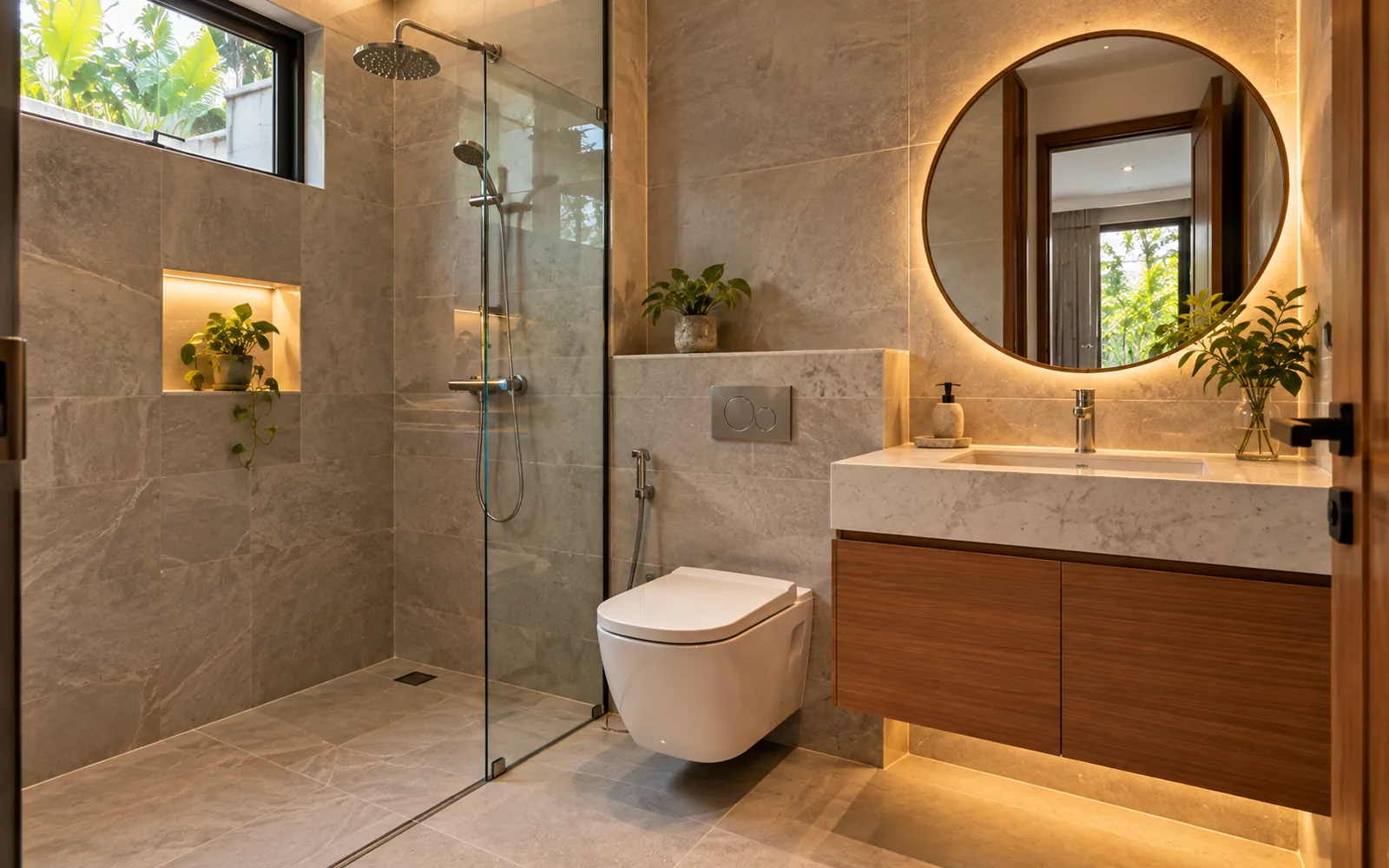
- Signature Rp42,000,000: marble or large-slab tiles, high-end Grohe or TOTO, wall-hung toilet, tempered glass.
The scope is for existing bathrooms: we review the waterproofing, replace sanitaryware where needed, then redo tiles and finishing details. The final price follows a survey, because pipework and room sizes vary.
For a more complete design concept, there are room packages:
- Powder room, about 2 m²: Rp16 / 28 / 55 million (Standard / Premium / Signature).
- Japandi ensuite, about 7 m²: Rp35 / 60 / 105 million.
- Warm stone bathroom, about 6 m²: Rp40 / 70 / 120 million.
Components you can add
If an existing bathroom only needs specific upgrades, some components can be ordered separately (Standard / Premium / Signature):
- Custom vanity with stone top and storage: Rp3.5 / 8 / 22 million per unit.
- Walk-in shower enclosure with frameless screen and tray: Rp3.5 / 7.5 / 16 million.
- Backlit mirror: Rp900k / 2.4 million / 7 million.
- Installed water heater: Rp3.5 million (30 L electric) / Rp4.2 million (instant gas) / Rp18.8 million (80 L heat pump), including unit, installation and a short hot-water run.
- Wall tiling service: Rp200 / 330 / 650k per m².
For leaks without a full overhaul, there is a wet-area waterproofing refresh from Rp95,000/m² (Premium Rp160,000, Signature Rp250,000): find the leak points, repair the membrane, then restore the finish.
Light refresh or full renovation?
Not every bathroom needs stripping out. Some simple rules:
- A light refresh is enough if there is no seepage, the pipes work and you only want new sanitaryware, taps, a mirror or vanity. Components can be ordered separately without lifting tiles.
- Walls can be overlaid. According to one contractor, new tiles can be fixed over old wall tiles with a suitable adhesive, as long as the old tiles are firmly bonded.
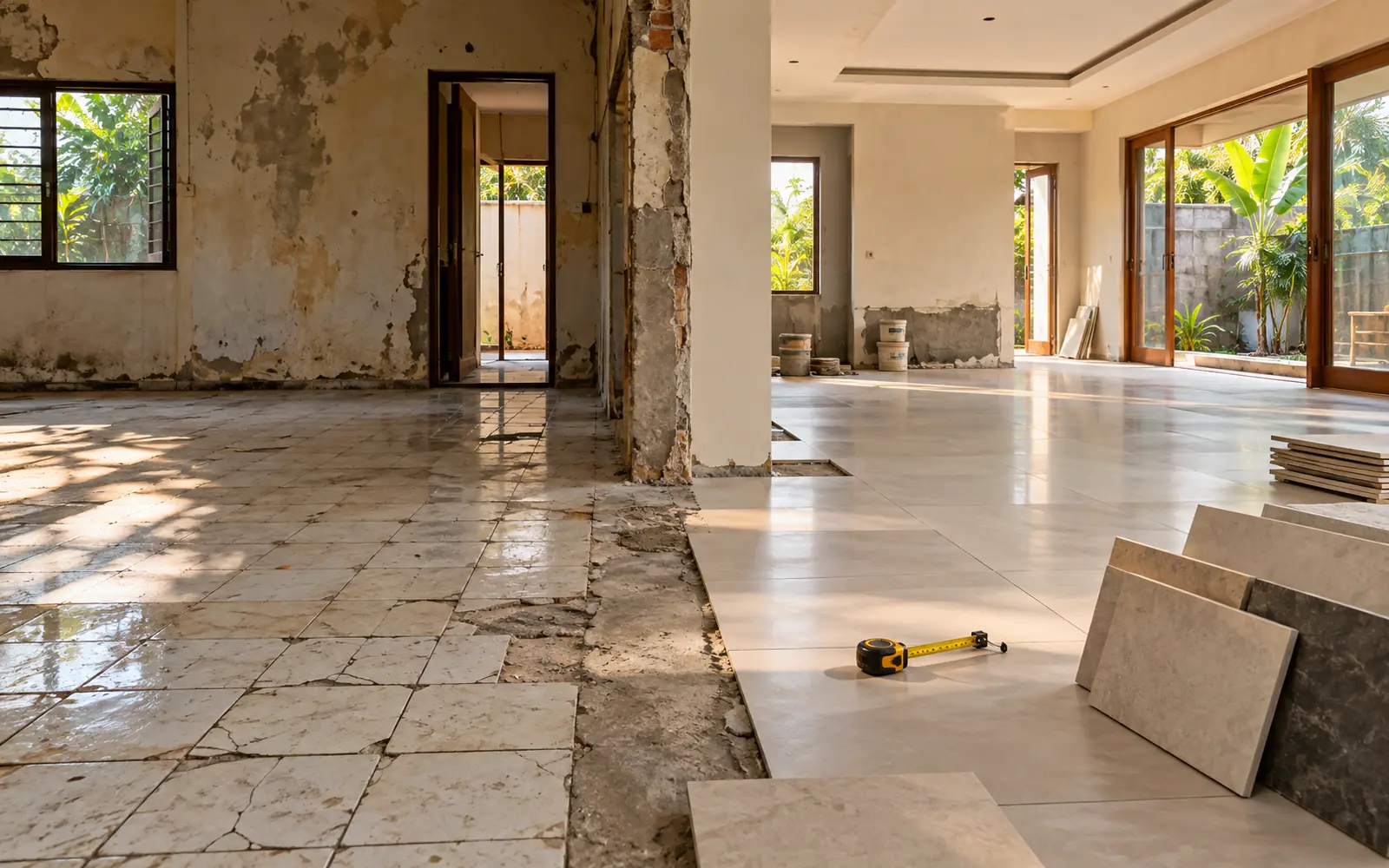
- Floors should be lifted if there is leaking or ponding, because the waterproofing and fall have to be redone from the base.
- A full renovation is needed if there are damp stains in the next room or ceiling below, hollow or loose tiles, drain smells or old pipework.
A survey helps confirm what is really needed, so you do not pay for demolition you do not need.
Choosing the right materials
Floor tiles. Choose slip-resistant or textured finishes, since bathroom floors are almost always wet. Medium-size tiles are easier to lay to a fall than very large slabs.
Wall tiles. Large formats such as 30×60 or 60×120 mean fewer grout lines and a roomier look, but need flat walls and careful fixing. To save money, tile to the ceiling only in wet zones; dry areas can stop at about 120 cm with moisture-resistant paint above.
Toilet. A close-coupled floor-standing toilet is the most practical for most homes. A wall-hung toilet looks neat and makes floor cleaning easier, but needs a frame and concealed cistern in the wall, so it costs more and involves more work.
Shower. A glass screen keeps the dry zone dry and reduces splashing onto other walls. Make sure the glass is tempered.
Taps and floor drains. Used every day, they fail fastest when cheap. This is not the place to economise.
Making a small bathroom feel bigger
- Use a wall-hung vanity so more floor is visible and easy to clean.
- Use clear glass screens instead of curtains or solid walls.
- Choose large, light-coloured wall tiles with matching grout.
- Fit a wide mirror, or a backlit one, to add depth.
- Build a wall niche in the shower for toiletries instead of extra shelving.
What affects the cost most
- Area and height of wall tiling. Tiling every wall to the ceiling uses far more than tiling wet zones only.
- Moving pipe points. Shifting the toilet or shower means opening the floor and running new pipes.
- Sanitaryware class. Mid-range and high-end toilets can differ by several million for the same basic function.
- Tile size and type. Large slabs and marble need more material and more skilled fixing.
- Shower glass and wall-hung toilets. These add frames, concealed cisterns and fixing details.
- Location. An upstairs bathroom needs extra waterproofing because leaks show in the ceiling below.
- Existing condition. Corroded pipes or floors without a fall need basic repairs first.
Budget examples
Example 1: a 2 × 2 m bathroom, MEETS Standard package.
- Standard bathroom renovation package: Rp15 million.
- 30 L electric water heater: Rp3.5 million.
- 11% VAT on top of the works.
Total before VAT is about Rp18.5 million, against a market range of Rp15–23 million for this size.
Example 2: a main bathroom with glass shower, Premium.
- Premium bathroom renovation package: Rp25 million.
- Premium walk-in shower enclosure: Rp7.5 million.
- Premium backlit mirror: Rp2.4 million.
Total before VAT is about Rp34.9 million. Check in the final quote whether any add-on is already partly covered by the package, so nothing is counted twice.
How to stop a bathroom leaking
This is what decides how long a bathroom lasts.
- Strip back to the screed and check pipework while everything is open.
- Lay the floor to a fall of about 1–2% towards the drain, with no low spots.
- Apply waterproofing to floor and walls. Manufacturers such as Sika recommend taking the wall coat at least 20 cm up from the floor, with reinforcement at corners. Many contractors take it to about 150 cm in the shower zone, because water splashes onto the walls.
- Flood test before tiling. Plug the drain, flood the floor, mark the water level and check. Sika recommends at least 2 × 24 hours; if anything seeps, repair and test again.
- Tile walls first, then the floor, and fill grout joints completely.
- Make sure ventilation works. Without a window, fit an exhaust fan so the room is not permanently damp.
Waterproofing is the item most often cut to save money, yet it is small compared with tearing out the whole bathroom after a leak.
Upstairs bathrooms need extra care
Leaks from an upstairs bathroom show as stains on the ceiling below, and the source is hard to trace because water can travel inside the floor before it drips. So:
- Add extra waterproofing around the floor drain and pipe penetrations.
- Make sure the flood test really happens and check the result together before tiling.
- Inspect the waste pipe run under the floor, including joints and falls.
- Provide an access hatch in the ceiling below where possible, so future checks do not mean opening up a lot.
Questions to ask your contractor
- Will the old floor be stripped back to the screed?
- Which waterproofing product, how many coats, and how high up the walls?
- Will there be a flood test, for how long, and can I see the result?
- Which brands and series of sanitaryware, taps and floor drain?
- Is debris removal included?
- How long will it take, and what is the warranty on leaks?
How long does it take?
As a market guide, a full bathroom renovation usually takes about 10–18 working days, including waterproofing cure time and flood testing. Moving pipes can add a few days. If your home has only one bathroom, plan a temporary alternative before work starts.
Common mistakes
- Waterproofing only the floor.
- Skipping the flood test to save time.
- Choosing floor tiles that are slippery when wet.
- Moving the toilet without allowing for waste routes and pipe falls.
- Forgetting sockets for a water heater or backlit mirror.
- Saving on floor drains and taps, which get used every day.
Checklist before a bathroom renovation
- Room size and photos of the current state, including any leak points.
- A decision on whether toilet, shower and basin positions stay.
- Wall and floor tile choices (slip-resistant for floors).
- Sanitaryware brands and series.
- Water heater needs and power points.
- A temporary bathroom plan.
- A written quote that states waterproofing, wall coating height and flood testing.
Renovating your bathroom with MEETS
MEETS renovations start with a survey, followed by a quote with written scope and specification. Payments follow progress: 30% down, then 17.5% at each of 25%, 50%, 75% and 100% physical progress on handover. Finishes and installations carry a 2-year warranty from handover, while manufactured products such as sanitaryware follow the factory warranty.
Read about our home renovation service, estimate your home in the calculator, or send photos and measurements of your bathroom via WhatsApp 0811-1532-118.
Related guides
If this topic overlaps with what you need, continue with:
Common questions
What does a 2 × 2 m bathroom renovation cost?
Market ranges are about Rp15–23 million for standard spec and Rp23–33 million for upper-mid. The MEETS bathroom renovation package starts at Rp15 million (Standard), excluding VAT, final after survey.
What does the MEETS Standard bathroom package include?
Waterproofing, tiles, INA or Onda sanitaryware and an HPL vanity, for an existing bathroom of about 4 m².
How much does bathroom waterproofing cost?
On the market, about Rp1.2–2.5 million for a 3 m² bathroom. The MEETS wet-area waterproofing refresh starts at Rp95,000/m².
How high should wall waterproofing go?
Sika recommends at least 20 cm from the floor. Many contractors take it to about 150 cm in the shower zone because water splashes onto walls.
How long does a bathroom renovation take?
Typically about 10–18 working days according to market contractors, including waterproofing cure time and flood testing.
What usually blows the budget?
Demolition, debris removal and plumbing repairs, especially when moving the toilet or shower, plus sanitaryware upgrades mid-project.
Other articles
Swipe right to see more guides.
From the guide to the build
Pick a relevant design, assemble your project, then ask MEETS to set the next step.