
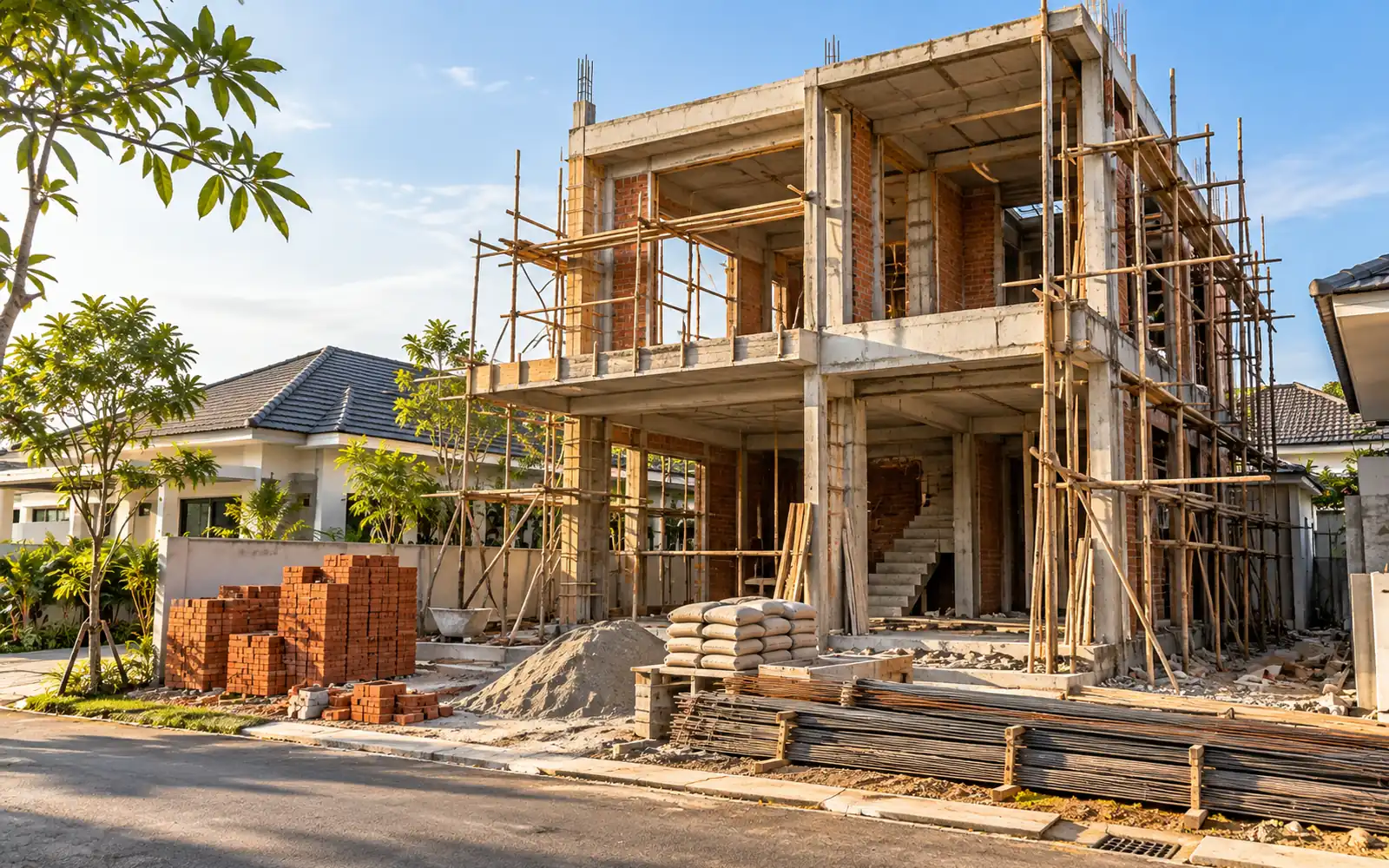
Working with a contractor
House Construction Priced per m²: Full Turnkey vs Labour-Only Contracts
Per-m² house building explained: turnkey vs labour-only contracts, what the rate covers, one and two-storey rates, payment terms and quote checks.
Dua penawaran dengan harga per m² yang sama bisa berisi lingkup pekerjaan yang sangat berbeda.
"How much per square metre?" is the first thing almost everyone asks a builder. The trouble is that one contractor might say Rp1.3 million and another Rp5 million, and both can be honest. What differs is what they are selling: labour only, or a finished house with materials.
This guide is not a cost table by house type (that lives in our build cost per m² guide). It is about contract models: what a per-m² price means, turnkey versus labour-only, what is usually included, and how to compare quotes so you do not regret it halfway through.
What a per-m² price means in a contract
A per-m² price is a way to summarise a contract so it can be compared. Behind it there is still a list of works and a specification. Three things must be clear before you trust a per-m² number:
- Which area is counted. At MEETS, floor area is the sum of all floors, including covered terraces. Other contractors may treat carports or balconies differently.
- Who supplies materials. This is what separates turnkey from labour-only.
- Which stage it reaches. Ready to live in, or only structure and walls.
As an illustration, the per-m² price in the MEETS catalogue is really a combination of parts: a base structural rate, a finishing rate per m², a bathroom package, a kitchen package, house utilities (septic tank, water tank, pump, panel), stairs where needed, and the carport. That is why the rate per m² shifts when the number of bathrooms or floors changes, even at the same size.
Full turnkey vs labour-only
Turnkey (borongan penuh). The contractor supplies materials and labour at a fixed price for an agreed scope and specification. You pay in stages as work progresses.
Labour-only (borongan tenaga). You buy all materials; the contractor or foreman is paid to build, usually per m² of floor area.
Day rate (harian). Workers are paid per day. You buy materials and direct the work daily.
The biggest difference is who carries the risk:
- Material price rises: on turnkey the contractor carries it; on labour-only and day rate, you do.
- Wrong or poor-quality materials: on turnkey the contractor is responsible to the written spec; on labour-only the contractor only answers for workmanship.
- Work stopping because materials are late: on labour-only, timing purchases is your job.
- Your supervision time: low on turnkey, medium on labour-only, high on day rate.
Market ranges in 2026 (general estimates from several contractors):
- Labour-only: about Rp1–1.9 million/m², with Jakarta towards the top.
- Turnkey: about Rp3.5–7 million/m², depending on specification.
- Day rates: about Rp120–250k per worker per day, more for a foreman.
Do not assume labour-only is cheaper. Once materials are added, the total is often close to turnkey. The difference is that the savings, or the overruns, are now in your hands.
When to choose which
Turnkey suits you if:
- You work full time and cannot be on site every day.
- You need a fixed total for financing or a mortgage.
- It is a new house or a full renovation with a clear scope.
- You want one party responsible for quality and warranty.
Labour-only can make sense if:
- You understand material specs and have good supplier contacts.
- You have time to schedule deliveries around each stage.
- The job is small, or you have materials you want to use up.
What is usually included, and what is not
In MEETS house packages (a turnkey model), scope is tiered.
Core covers preparation, foundations, concrete structure, rendered and skimmed brick walls, and a light-steel roof frame with sand-coated metal tiles.
Standard and above add floors, frames, doors and windows, ceilings, paint, sanitaryware, water, electrical and lighting installations, a one-car carport, a complete bathroom package, a kitchen package (counter and sink) and house utilities.
Not included: 11% VAT, additional works, special site conditions such as fill or raising the ground, and items like upper and lower kitchen cabinets, built-in wardrobes, AC, water heaters, carport canopies, fences, pools, landscaping and furniture.
Whoever you get quotes from, check these lines, because they cause most of the gaps:
- Site preparation: clearing, setting out, site office, temporary power and water.
- Foundations: type and depth, and any assumption about ground conditions.
- Septic tank, well or mains connection, water tank and pump.
- Electricity connection and capacity.
- Frames: aluminium, timber or uPVC, and glass thickness.
- Brand and series of sanitaryware, tiles and paint.
- Debris removal and final cleaning.
- Design, working drawings and PBG building approval.
Rates per m² for one vs two storeys
Two-storey houses usually cost more per m² because of stairs, the upper structure and work at height. From the MEETS table (Standard package):
- Single storey 100 m² (4 bed, 2 bath): Rp511 million, about Rp5.1 million/m².
- Two storeys 72 m² (3 bed, 3 bath): Rp408 million, about Rp5.7 million/m².
- Two storeys 96 m² (3 bed, 3 bath): Rp528 million, about Rp5.5 million/m².
- Two storeys 120 m² (4 bed, 4 bath): Rp659 million, about Rp5.5 million/m².
- Two storeys 150 m² (5 bed, 4 bath): Rp809 million, about Rp5.4 million/m².
The fairest comparison is the same area. In the MEETS calculator, a 100 m² house with 3 bedrooms and 2 bathrooms on Standard is about Rp511 million on one floor (4–5 months) and about Rp537 million on two (5–7 months), a difference of roughly Rp26 million.
Note too that the rate per m² falls as houses get bigger, because fixed items such as bathrooms, kitchen and utilities are spread over more area.
What moves the rate per m²
Two houses of the same size can have different rates per m². The factors that most often shift the number:
- Number of bathrooms. Each one brings sanitaryware, wall tiles, waterproofing and plumbing. A 100 m² house with 3 bathrooms costs more per m² than one with 2.
- Number of floors. Stairs and the upper structure add cost, as the comparison above shows.
- Finish level. At MEETS the range runs from Core at Rp3.5 million/m² to Signature at Rp7.5 million/m². The biggest jumps usually come from tiles, frames and sanitaryware.
- Roof type. A flat concrete roof is heavier and costs more than a light-steel frame with tiles.
- Site conditions. Ground that needs filling or raising, or soft soil needing deeper foundations, sits outside the package price and is priced after the survey.
- Access. Narrow streets, lanes trucks cannot enter, or estates with working-hour rules can affect haulage and duration.
So the per-m² figure works best as a starting point. Change bedrooms, floors and roof type in the MEETS calculator to see the effect on the total.
Turning a per-m² rate into a total
The formula is simple: total floor area × rate for the chosen level, then add items outside the package.
Example: you plan a two-storey 120 m² house on the MEETS Standard table, about Rp659 million. Then list the extras you want, such as upper and lower kitchen cabinets, AC, a carport canopy and a fence, plus 11% VAT on the contract value. Keep a reserve for site conditions that only show up after the survey. That gives you a realistic budget before you talk to any contractor.
Payment terms and retention
Healthy payment terms follow physical progress, not dates. MEETS construction terms are:
- 30% down payment at contract.
- 17.5% at 25% physical progress.
- 17.5% at 50%.
- 17.5% at 75%.
- 17.5% at 100%, on handover.
The down payment is deducted evenly from each invoice. Structural warranty is 5 years, finishes and installations 2 years from handover, with full terms in the contract.
Many construction contracts also include retention: a small part of the contract value (often 5%) held during a maintenance period and released after final handover. Retention is not the only way to protect an owner; a written warranty with clear terms does a similar job. Whatever the mechanism, it should be in writing.
Red flags: a very large upfront payment, weekly payments with no progress measure, or requests for full payment before handover.
How to compare contractor quotes
- Use the same area basis. Ask each contractor to state the area counted per floor, including terraces and carport.
- Ask for a bill of quantities by work package, not just a total per m². Compare line by line.
- Match the specification. Write brands and series for tiles, sanitaryware, paint, frames and roofing. "Equivalent" must say equivalent to what.
- Check the exclusions list. The cheapest quote is often cheap because many items are left out.
- Ask about ground assumptions. Is fill included? What happens on soft ground?
- Compare payment terms and warranty, not just price.
- Check legal identity and portfolio. A contract with a registered company, and real projects you can look at.
It also helps to understand why early estimates differ from a final bill of quantities; see early estimate vs RAB. A fuller question list is in what to ask before requesting a quote.
Quick example: two quotes for the same house
Say you are building a single-storey 70 m² house and receive two numbers:
- Contractor A: turnkey, ready to live in. For reference, the MEETS table puts a Type 70 on Standard at about Rp361 million.
- Contractor B: labour-only at Rp1.5 million/m² (an example in the middle of the market range): 70 × Rp1.5 million = Rp105 million in wages.
B looks like a third of A. But you still have to buy everything: cement, steel, bricks, roof frame, tiles, frames, sanitaryware, cable, pipes and paint. You also carry leftovers, price rises and the time spent managing it. Once materials are counted, the gap shrinks a lot, and the risk has moved to you.
Common mistakes
- Comparing labour-only prices with turnkey prices as if they were the same thing.
- Accepting a per-m² quote with no bill of quantities or specification.
- Not asking who handles the building approval.
- Paying a big deposit to someone with no company or written contract.
- Changing the design mid-way without a priced addendum.
Checklist before signing
- Working drawings and material specifications attached to the contract.
- Bill of quantities by work package, plus a list of exclusions.
- Schedule and how progress is measured.
- Payment terms tied to physical progress.
- Written warranty or retention, with time periods.
- How additions and omissions are handled.
- The contractor's company name, business ID (NIB) and address.
Building with MEETS
MEETS is the platform of PT Mitra Gusnita Nanda; contracts, invoices and warranties are issued in the company's name. Our house packages are turnkey, with the same per-m² rates in the catalogue and the calculator, adjusted after a free site survey. House projects in our portfolio include Kilauan Residence Depok, a cluster home built from structure to finishes. For projects in the capital, the Jakarta house contractor page uses the same catalogue rates as the calculator, with access and site adjustments set after the survey. Beyond houses we also handle renovation, fit-out and facilities; see construction services.
Browse designs in the house catalogue, read how we work on the house building page, or send your plot size and room needs via WhatsApp 0811-1532-118.
Related guides
If this topic overlaps with what you need, continue with:
Common questions
What does house construction cost per m² in 2026?
It depends on the model. As a market guide, labour-only runs about Rp1–1.9 million/m² and turnkey about Rp3.5–7 million/m². The MEETS turnkey Standard package for a ready-to-live single-storey home is about Rp5 million/m² before 11% VAT.
What is the difference between turnkey and labour-only?
Turnkey means the contractor supplies materials and labour at a fixed price. Labour-only means you buy materials and the contractor is paid for the work. Under labour-only, material price and quality risks move to you.
What is the rate per m² for a two-storey house?
On the MEETS Standard table, two-storey homes are about Rp5.4–5.7 million/m² depending on size; 120 m² is about Rp659 million. At the same area, two storeys cost slightly more than one because of stairs and the upper structure.
Is labour-only cheaper?
The wage bill looks much smaller, but once materials are added the total is often close to turnkey. It can save money if you know materials and have time to manage purchasing; otherwise it can overrun.
What payment terms are safe?
Terms tied to physical progress. At MEETS: 30% down, then 17.5% at each of 25%, 50%, 75% and 100% progress on handover. Avoid large upfront payments with no progress measure.
What should a contractor's quote include?
The area counted, a bill of quantities by work package, material specs and brands, exclusions, schedule, payment terms, warranty and the contractor's registered company details.
Other articles
Swipe right to see more guides.

From the guide to the build
Pick a relevant design, assemble your project, then ask MEETS to set the next step.